

HR220PA-1
Overview
Tag any gene with GFP
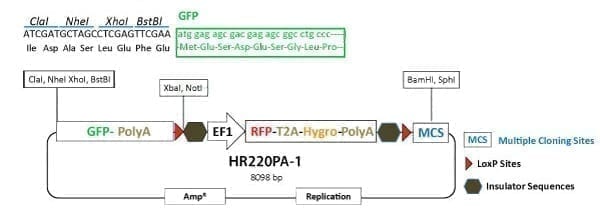
Use the PrecisionX™ Gene Tagging HR Targeting Vector (GFP-pA-LoxP-EF1α-RFP-T2A-Hygro-pA-LoxP-MCS) to fuse GFP to any gene in the genome. Clone your homology arms into the two MCSs and use hygromycin selection and RFP-positive imaging to find integrants. After you’ve identified clones with your GFP-tagged gene, you can remove the selection cassette using the Cre-LoxP system.
Why use an HR targeting vector?
Even though gene knock-outs can result from DSBs caused by Cas9 alone, SBI recommends the use of HR targeting vectors (also called HR donor vectors) for more efficient and precise mutation. HR donors can supply elements for positive or negative selection ensuring easier identification of successful mutation events. In addition, HR donors can include up to 6-8 kb of open reading frame for gene knock-ins or tagging, and, when small mutations are included in either 5’ or 3’ homology arms, can make specific, targeted gene edits.
Choose the right HR Targeting Vector for your project
| Catalog # | HR Donor Vector | Features* | Application |
|||
|---|---|---|---|---|---|---|
| Gene |
Gene |
Gene Edits | Gene Tagging | |||
| HR100PA-1 | MCS1-LoxP-MCS2-MCS3-pA-LoxP-MCS4 | Basic HR Donor | ✔ | ✔ | ||
| HR110PA-1 | MCS1-EF1α-RFP-T2A-Puro-pA-MCS2 | Removable RFP marker and puromycin selection | ✔ | ✔ | ||
| HR120PA-1 | GFP-pA-LoxP-EF1α-RFP-T2A-Puro-pA-LoxP-MCSPuro-pA-LoxP-MCS | Tag with GFP fusion Removable RFP marker and puromycin selection |
✔ | |||
| HR130PA-1 | T2A-GFP-pA-loxP-EF1α-RFP-T2A-Puro-pA-LoxP-MCSA-loxP-EF1α-RFP-T2A-Puro-pA-LoxP-MCS | Co-express GFP with “tagged” gene via T2A Removable RFP marker and puromycin selection |
✔ | |||
| HR150PA-1 | GFP-T2A-Luc-pA-loxP-EF1α-RFP-T2A-Puro-pA-LoxP-MCS | Tag with GFP fusion and co-express luciferase via T2A Removable RFP marker and puromycin selection |
✔ | |||
| HR180PA-1 | IRES-GFP-pA-loxP-MCS1-EF1α-RFP-T2A-Puro-pA-LoxP-MCS2 | Co-express GFP with “tagged” gene via IRES Removable RFP marker and puromycin selection |
✔ | |||
| HR210PA-1 | MCS1-LoxP-EF1α-GFP-T2A-Puro-P2A-hsvTK-pA-LoxP-MCS2 | Removable GFP marker, puromycin selection, and TK selection | ✔ | ✔ | ||
| HR220PA-1 | GFP-pA-LoxP-EF1α-RFP-T2A-Hygro-pA-LoxP-MCS | Tag with GFP fusion Removable RFP ,arker and hygromycin Selection |
✔ | |||
| HR410PA-1 | MCS1-EF1α-GFP-T2A-Puro-pA-MCS2 | Removable GFP marker and puromycin selection | ✔ | ✔ | ||
| HR510PA-1 | MCS1-EF1α-RFP-T2A-Hygro-pA-MCS2 | Removable RFP marker and hygromycin selection | ✔ | ✔ | ||
| HR700PA-1 | MCS1-EF1α-GFP-T2A-Puro-pA-MCS2-PGK-hsvTK | Enrich for on-target integration with negative TK selection** Removable GFP marker and puromycin selection |
✔ | ✔ | ||
| HR710PA-1 | MCS1-EF1α-RFP-T2A-Hygro-pA-MCS2-PGK-hsvTK | Enrich for on-target integration with negative TK selection** Removable RFP marker and hygromycin selection |
✔ | ✔ | ||
| HR720PA-1 | MCS1-EF1α-Blasticidin-pA-MCS2-PGK-hsvTK | Enrich for on-target integration with negative TK selection** Removable blasticidin selection |
✔ | ✔ | ||
| GE602A-1 | pAAVS1D-PGK-MCS-EF1α-copGFPpuro | First generation AAVS1-targeting HR Donor | ✔ | |||
| GE603A-1 | pAAVS1D-CMV-RFP-EF1α-copGFPpuro | First generation AAVS1-targeting HR Donor (positive control for GE602A-1) | ✔ | |||
| GE620A-1 | AAVS1-SA-puro-MCS | Second generation AAVS1-targeting HR Donor Promoterless to knock-in any gene or promoter-gene combination |
✔ | |||
| GE622A-1 | AAVS1-SA-puro-EF1α-MCS | Second generation AAVS1-targeting HR Donor Constitutive expression of your gene-of-interest |
✔ | |||
| GE624A-1 | AAVS1-SA-puro-MCS-GFP | Second generation AAVS1-targeting HR Donor Create reporter cell lines |
✔ | |||
| CAS620A-1 | AAVS1-SA-puro-EF1α-hspCas9 | Knock-in Cas9 to the AAVS1 site | ||||
| MCS1-5'PB TR-EF1α-GFP-T2A-Puro-T2A-hsvTK-pA-3' PB TR-MCS2 | Use with the PiggyBac Transposon System Enables seamless gene editing with no residual footprint (i.e. completely remove vector sequences) |
✔ |
|
|||
| *All HR Target Vectors except PBHR100A-1 contain LoxP sites. Any sequences that are integrated between the two LoxP sites can be removed through transient expression of Cre Recombinase. **The clever design of these HR Donors enables enrichment for on-target integration events. A PGK-hsvTK cassette is included outside of the homology arms. Because of this configuration, on-target integration that results from homologous recombination will not include the PGK-hsvTK cassette—only randomly-integrated off-target events will lead to integration of PGK-hsvTK and resulting TK activity. Therefore, TK selection will negatively select against off-target integrants. Click on any one of these vectors to see a diagram of how the negative selection works. |
||||||
How It Works
At-a-glance—how to use an HR Targeting Vector to knock-in a gene
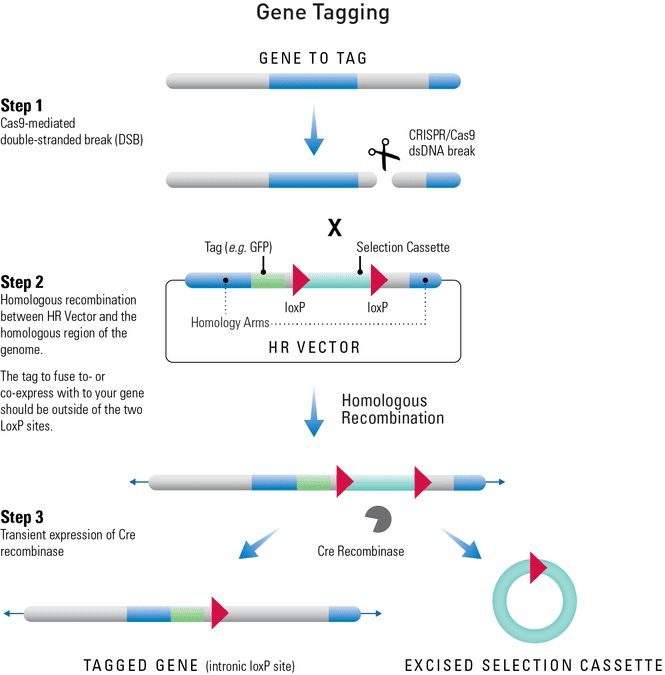
Figure 1. Tagging a gene using an HR Targeting Vector. Step 1: Cas9 creates a double-stranded break (DSB) in the genomic DNA at a site that is complimentary to the gRNA. Step 2: The DNA repair machinery is recruited to the DSB. In the presence of an HR Donor with homology to the region adjacent to the DSB (blue areas of the genomic and vector DNA) homologous recombination (HR) is favored over non-homologous end joining (NHEJ). The tag you’d like to fuse to a gene should lie outside of the two LoxP sites. Result: The HR event leads to insertion of the region of the HR Donor Vector between the two homology arms—your tag ends up fused your gene-of-interest and your selection cassette is integrated. To remove the selection cassette (leaving behind the tag and a single LoxP site), transiently express Cre recombinase.
Genome engineering with CRISPR/Cas9
For general guidance on using CRISPR/Cas9 technology for genome engineering, including the design of HR Targeting Vectors, take a look at our CRISPR/Cas9 tutorials.