

RA820A-1
Overview
Get your exosomal RNA profiling studies off the ground fast
- Reliable, reproducible exoRNA isolation from serum, plasma, or ascites fluid
- Sensitive detection via exoRNA amplification
- Everything you need including 384-well plate of human miRNAs for qPCR profiling
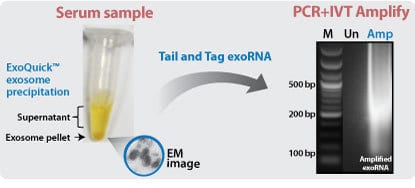
Choose the SeraMir Kit that’s right for you
| Cat. # | Name | Kit includes | |||
|---|---|---|---|---|---|
| ExoQuick or ExoQuick-TC | SeraMir RNA columns and reagents | SeraMir cDNA synthesis and amplification reagents | 384-well plate miRNAs for human, mouse, or rat | ||
| RA800A-1 | Complete SeraMir Exosome RNA Amplification Kit | ✔ | ✔ | ✔ | |
| RA800TC-1 | Complete SeraMir Exosome RNA Amplification Kit for Media and Urine | ✔ | ✔ | ✔ | |
| RA806A-1 | SeraMir Exosome RNA Purification Kit | ✔ | ✔ | ||
| RA806TC-1 | SeraMir Exosome RNA Purification Kit for Media and Urine | ✔ | ✔ | ||
| RA808A-1 | SeraMir Exosome RNA Purification Column Kit | ✔ | |||
| RA820A-1 | Human Complete SeraMir Exosome RNA Amplification and Profiling Kit | ✔ | ✔ | ✔ | ✔ |
| RA820TC-1 | Human Complete SeraMir Exosome RNA Amplification and Profiling Kit for Media and Urine | ✔ | ✔ | ✔ | ✔ |
| RA821A-1 | Mouse Complete SeraMir Exosome RNA Amplification and Profiling Kit | ✔ | ✔ | ✔ | ✔ |
| RA821TC-1 | Mouse Complete SeraMir Exosome RNA Amplification and Profiling Kit for Media and Urine | ✔ | ✔ | ✔ | ✔ |
| RA822A-1 | Rat Complete SeraMir Exosome RNA Amplification and Profiling Kit | ✔ | ✔ | ✔ | ✔ |
| RA822TC-1 | Rat Complete SeraMir Exosome RNA Amplification and Profiling Kit for Media and Urine | ✔ | ✔ | ✔ | ✔ |
How It Works
Quickly and easily profile exoRNAs
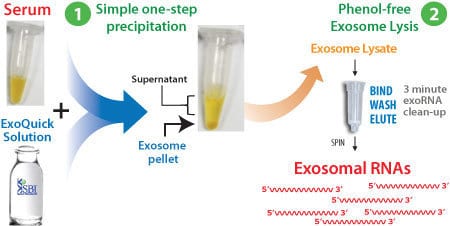
- Isolate exosomes from patient biofluids with the included ExoQuick reagent
- Purify exoRNAs with SeraMir columns
- Measure expression levels of 380 human miRNAs in a 384-well qPCR assay
Isolate serum exosomes and purify exoRNAs
Tail exoRNAs and synthesize double-tagged cDNA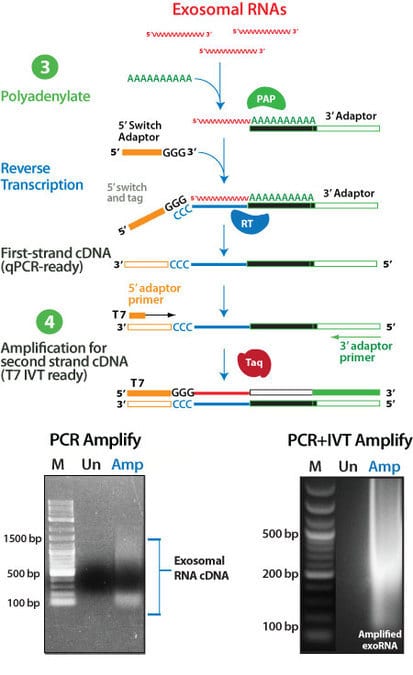
Three validated reference controls included on the SeraMir Profiling qPCR plate
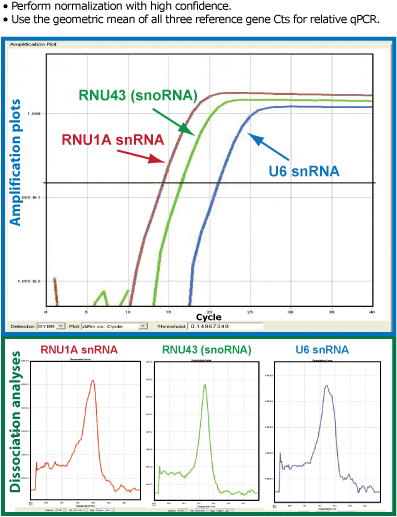
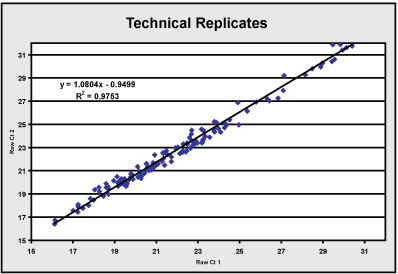
Excellent technical replicates across an 8-log range
Supporting Data
Better qPCR profiling with SeraMir
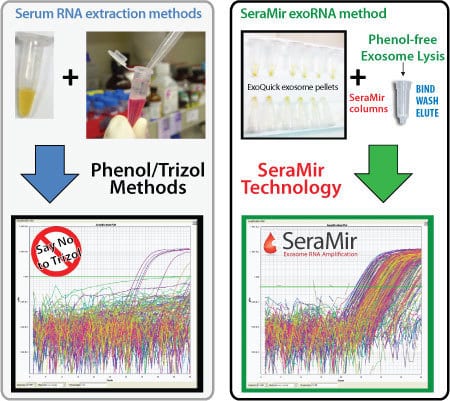
Figure 1. Serum RNA prepared by the SeraMir Kit delivers more reliable, reproducible qPCR profiles than when the RNA is isolated using conventional Trizol methods. Profiling of 380 Human microRNAs across the SeraMir 384 Profiler. The phenol-free exosome lysis step coupled to the small RNA binding columns isolates exoRNAs with much higher purity than Trizol/Phenol based methods. The SeraMir exoRNAs are compatible with downstream polyadenylation and reverse trancription reactions for amplification and accurate qPCR profiling.
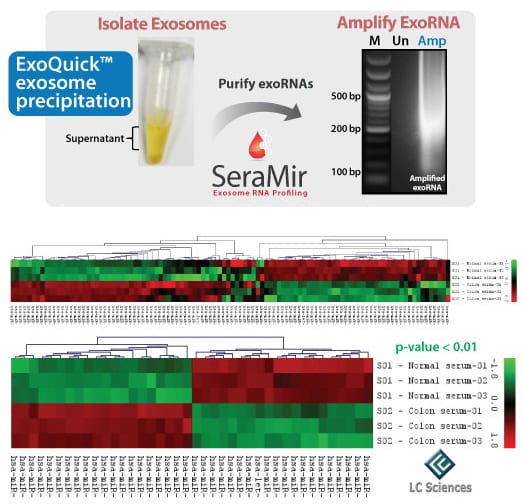
Figure 2. Serum exoRNAs prepared using SeraMir deliver excellent performance in microarray studies. Samples from a pooled normal serum preparation and from a male caucasian (age 73) with adenocarcinoma of the colon were used in this study. Exosomes were precipitated from 250 µL of serum using the SeraMir Exosome RNA Amplification Kit. The T7-amplified “sense” exoRNAs were then used for direct labeling analyses on LC Sciences miRBase ver.16 array chips (performed in triplicate). The exoRNAs were hybridized across 1,214 different microRNAs on the probe set.
Of the 1,214 microRNAs analyzed, 79 microRNAs showed a signal intensity >32. Within this set of 79, there was a clear colon versus normal “signature set” of 40 microRNAs that could discriminate normal from colon cancer serum samples with a p-value < 0.01. The identities of the microRNAs found in this study have been masked while further investigation continues.